How ArcTouch designers use AI vibe coding tools to build, test, and validate ideas faster
7 min. read - June 16, 2026
Get our newsletter in your inbox.
We help companies of all sizes build lovable apps, websites, and connected experiences.
Prototyping used to mean representing an idea. Increasingly, it means building one.
For years, early-stage product development followed a familiar pattern: turn whiteboard sketches and sticky notes into static user flows and disconnected screens — and then, eventually, if there was sufficient time or budget, something real. But as AI-powered tools evolve, that gap between idea and reality has shrunk.
Vibe coding, in particular, makes it possible to build and test working prototypes with users in hours or days instead of weeks. That changes how quickly product teams can learn what works.
I saw this firsthand during a recent ArcTouch Discovery workshop with a Fortune 100 tech client. We set out to define and prototype a new internal app experience in just a few days — a timeline that seemed impossible a year ago.
By the third day, we had a functional, working prototype. Not static screens. Something we could put in front of users and test immediately.
That’s when it became clear: This wasn’t just faster prototyping. It was a different way of working.
Instead of just describing what we might build, we're now building it and learning what works on the spot. We can test and validate ideas quickly. And in some cases, help clients realize just as quickly that we shouldn’t build something at all.
That ability to learn and fail or change course sooner is just as valuable as speed.
This experience was the inspiration for an internal training program we call Vibe with Me.
My first vibe coding experience came in early 2025 via the Vercel AI hackathon that ArcTouch participated in. The event challenged teams to build functional e-commerce applications in less than three weeks, using Vercel's v0 generative coding tool, its AI SDK, and other MACH architecture technologies.
For the first time, I was building prototypes that behaved more like real products — connecting to APIs, working with live data, and responding dynamically. Instead of just designing static prototypes, I could actually build the whole experience.
It was both a forcing function and a turning point in how I work.
I also realized something quickly: My colleagues who didn’t participate in that hackathon needed their own turning point. I wanted more of our designers to feel comfortable experimenting with these tools, understand their potential, and see how they fit into real product work.
Without that kind of forcing function, it’s easy to hesitate. The tools are new, the space is evolving quickly, and it’s not always clear where to start. And with most designers fully allocated to client work, finding time to experiment isn’t simple.
We created Vibe with Me to give our digital product designers a structured, low-pressure way to explore vibe coding and build confidence using these tools. And the emphasis was on fun.
The program is built around a few core principles:
Lower the barrier to entry and encourage participation
Prioritize hands-on building over passive learning
Help designers understand where vibe coding adds real value
It runs as a five-week program with small cohorts meeting regularly, but the core of the experience isn’t lectures; it’s building. Every participant creates a working project, culminating in a demo day where everyone presents their creations. It’s like summer camp for designers.
The progression is simple: Start with playful experiments, move into more polished interactions, explore practical product concepts, and finish with a personal project.
The goal isn’t to produce fully shippable products. It’s to create a tangible learning experience that helps designers get comfortable with these tools — and start applying them in real work.
Before each cohort started, I gave a simple brief: Build something that solves a small problem for you and makes you smile. The idea should be universal, executed simply, with some element of play, nostalgia, or beauty.
The designers built a wide range of projects:
AI-generated school labels and tags
Vegan blog for recipes and restaurant recommendations
Gaming catalog connected to external data
A real-time parking concept
Classic Chair Miniature builder
An internal timesheet tool
A story-based planning tool
A gamified productivity app that cures tech FOMO
Offline Sudoku mobile game
A Tinder-style pet adoption app
432 Hz music creator
AR drawing coach concept
Climate spiral data visualization
A Canva-like tool for creating and exporting illustrated books
We also introduced a bit of friendly competition. Projects were recognized for being the most playful, the most polished, and the most practical — whether that meant a delightful concept, strong visual and interaction design, or deeper technical functionality.
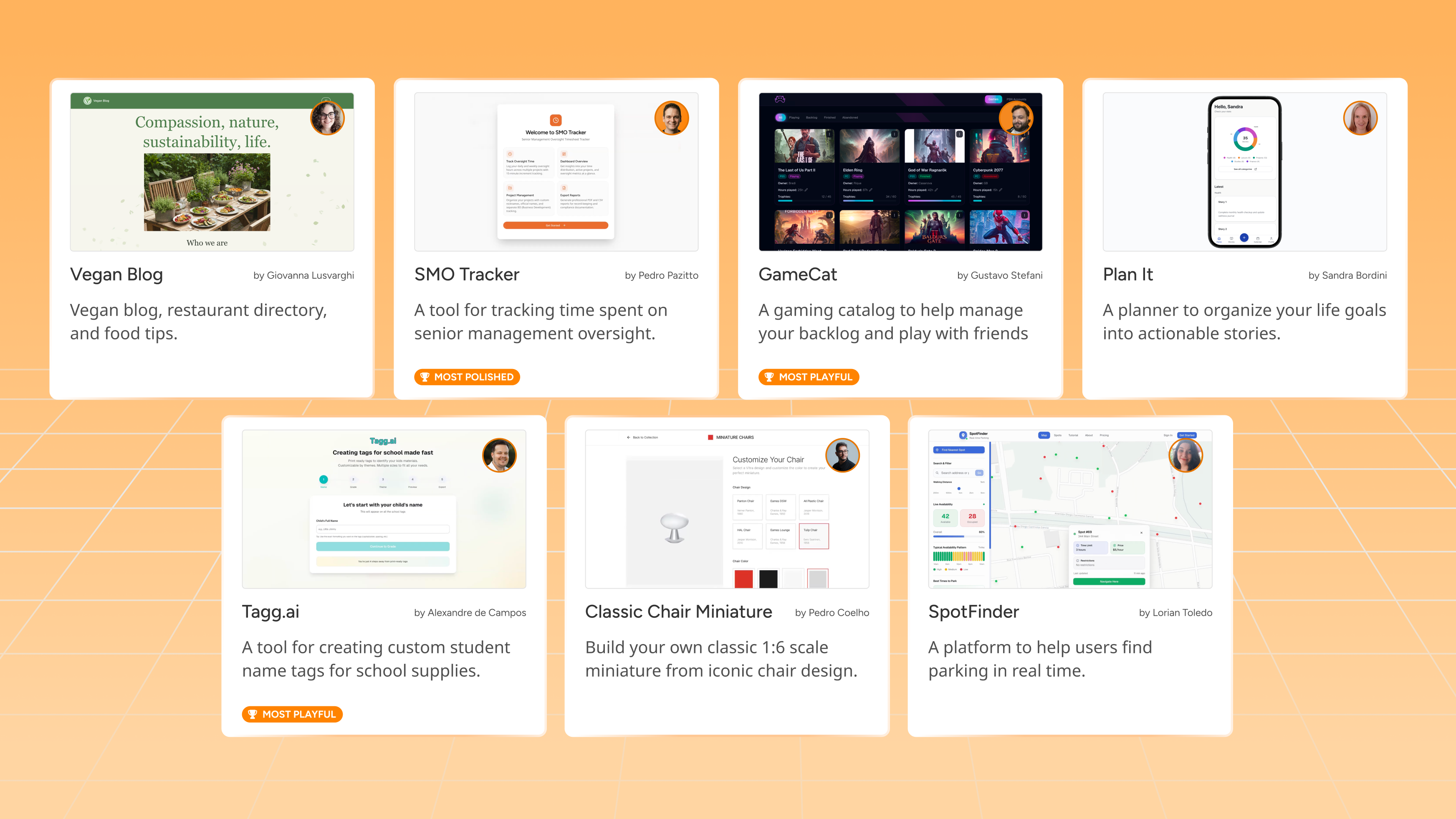
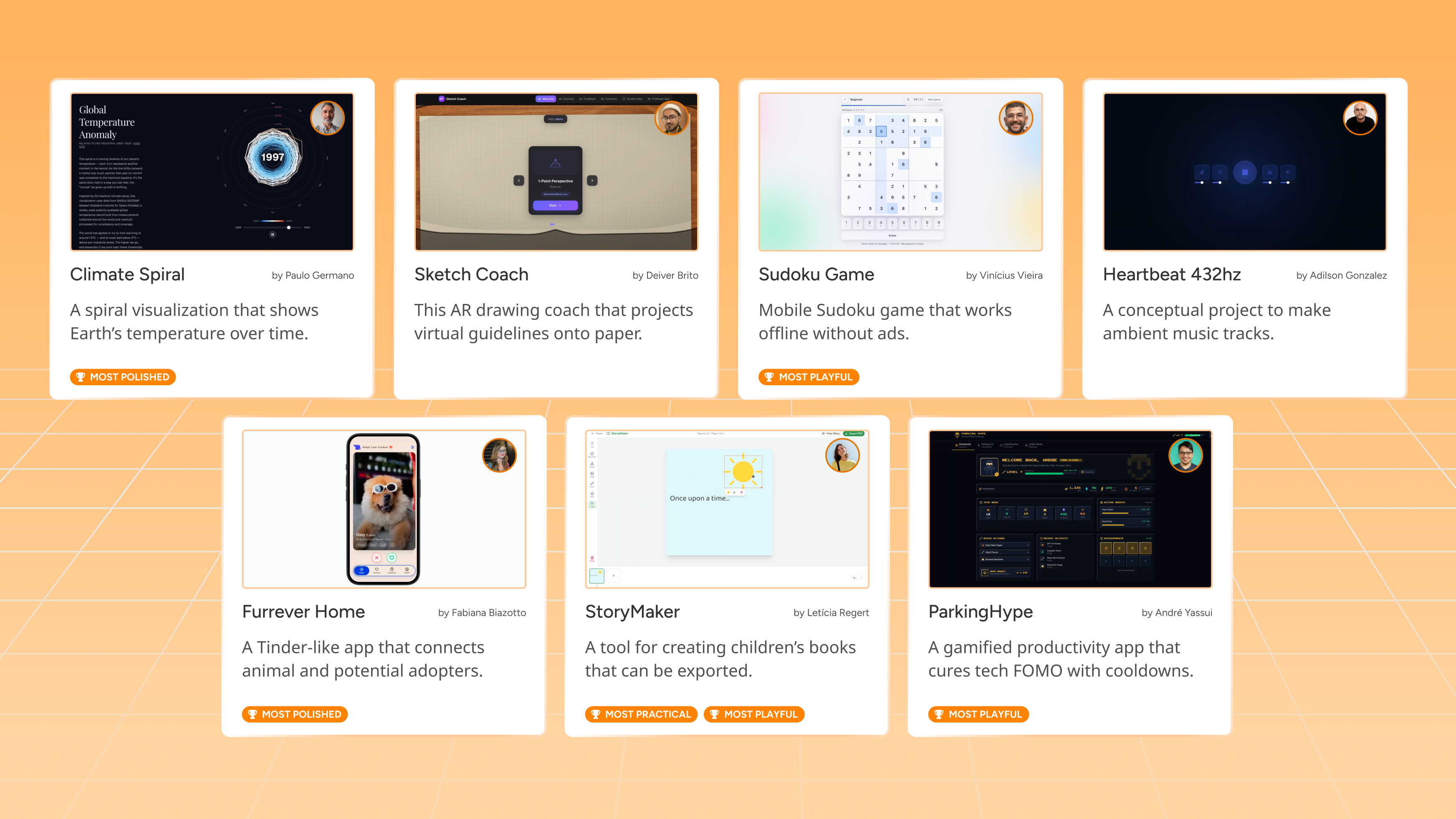
Most of these were built in roughly 20 hours, often concentrated in the final week.
What stood out to me was the range. The projects were far more creative, more polished, and more technically ambitious than I expected, especially given the limited time.
That variety reflects the goal: not to build production-ready apps, but to explore what becomes possible when ideas can be turned into working prototypes quickly.
What stood out to me wasn’t just what people built. It was how quickly their mindset shifted.
Designers who had never used these tools were, within a few weeks, building complex, convincing prototypes. More importantly, they became more comfortable experimenting, not just with vibe coding, but with other AI tools.
One participant described the experience this way:
“I didn’t know where to start with AI tools before. Now I feel like I can actually build things and test ideas on my own.”
Another highlighted the impact on real project work:
“This is very useful for the initial moments of a project, creating working wireframes and testing hypotheses with clients much faster.”
Instead of describing an interaction or pitching a concept, designers can show it. That makes it easier to align with product managers and engineering. And it helps us align with our clients’ expectations earlier as well.
A simple way I think about it: Traditional design tools help you represent an idea. Vibe coding helps you experience it.
That shift is especially powerful in early-stage concepting and discovery, where speed and clarity matter most. Designers can test ideas that would have previously required engineering support — pulling in live data, connecting to APIs, or building real interactions.
But there are limits.
These tools are strongest early. As projects grow more complex, they become harder to refine and scale. Most prototypes reach something like “50% of the way there” — enough to test, learn, and iterate, but not ready for full production.
Bridging that gap means integrating with real systems and backends, ensuring consistency across the product, meeting accessibility standards, and fully hardening the experience. This is where traditional design and engineering workflows still play a critical role.
One other shift is clear: vibe coding isn’t just changing how we build, it’s changing how we think.
The work becomes less about writing code and more about clearly describing what you want to create. The designers who made the most progress weren’t the most technical. They were the ones who were most curious and who could articulate their ideas, test them quickly, and refine them through iteration.
In that sense, vibe coding doesn’t lower the bar for design. It raises it.
The shift here isn’t just about new tools. It’s about how ideas move from something you describe to something you can actually try.
When teams can test ideas earlier, they make better decisions. They validate what works and recognize what doesn’t before investing too much time and effort.
For me, that’s the most exciting part of vibe coding. It changes not just how quickly we build, but how confidently we decide what’s worth building at all.
And once you experience that shift, it’s hard to go back.
Interested in how your team can move from ideas to working prototypes faster and validate what’s worth building before investing too much time?
At ArcTouch, we help product teams bring concepts to life quickly through rapid prototyping, collaborative discovery workshops, and innovation sprints.
Contact us to explore how we can help you test, validate, and build your next lovable product.