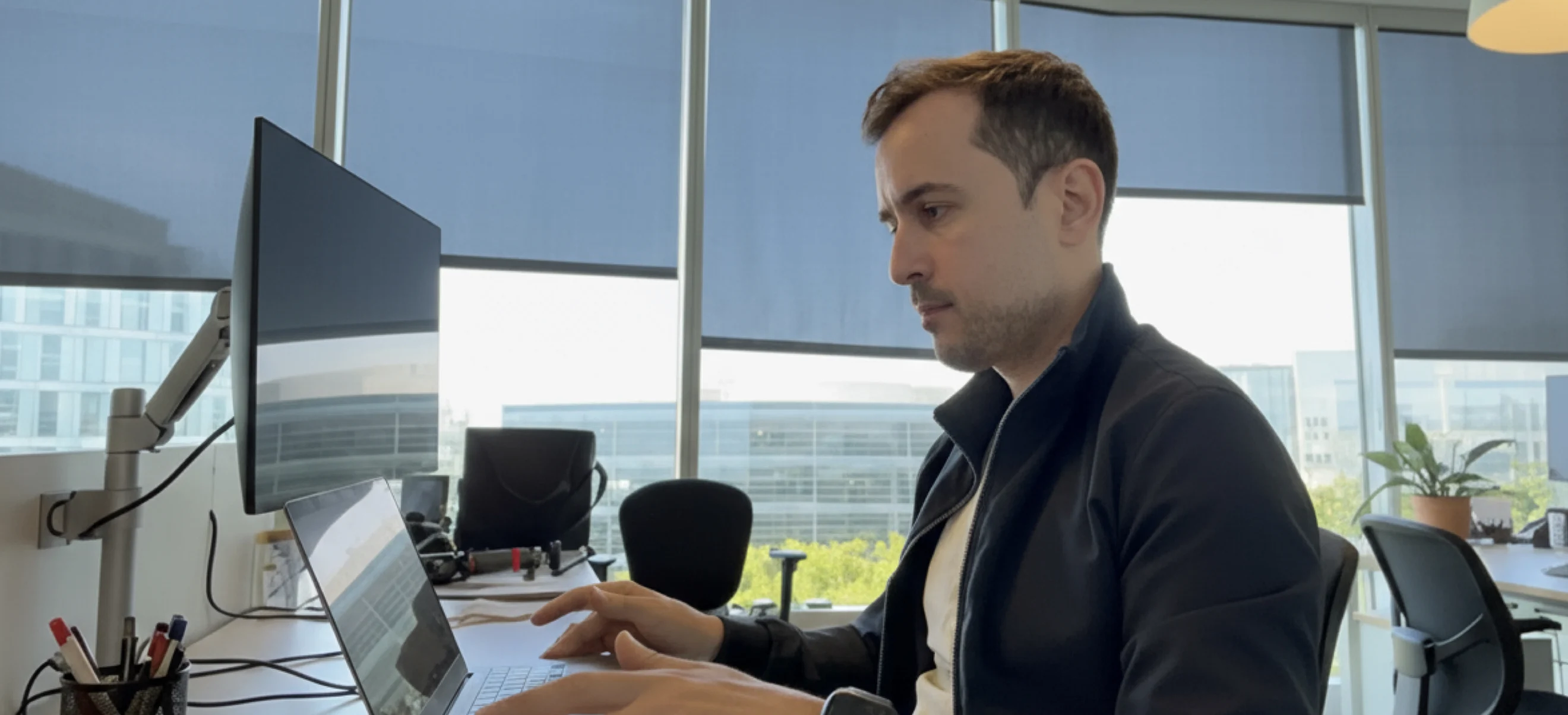
App maker spotlight: Luciano Ayres, director of AI
With a people-first mindset, he’s shaping an AI strategy that accelerates app development without losing the human craft behind building apps that are lovable
We help companies of all sizes build lovable apps, websites, and connected experiences.
[Editor’s note: This is part of a series of articles about app makers, highlighting ArcTouch team members. The app makers we feature crave getting their hands on the latest products and finding creative new ways to apply technology to their projects.]
ArcTouch’s director of artificial intelligence, Luciano Ayres, has spent more than two decades building software, leading engineering teams, and shaping how culture and technology intersect. With a background in deep learning and human-centered product thinking, he has applied AI practically — not as a concept, but as a tool to solve real business challenges.
Before joining ArcTouch, he spent over 15 years leading innovation teams and launching products across multiple digital platform shifts. He also helped build and oversee a large AI-assisted coding community, defining processes and toolsets used by thousands of developers.
Today, he helps ArcTouch strategists, designers, and engineers use AI responsibly — not to replace their expertise, but to amplify it and the proven process ArcTouch has successfully used to create over 500 apps since 2008.
“I think of our people as Formula One drivers,” he says. “They’re high-performing professionals who know the track and master their tools. AI is a better car with a faster engine. The more they understand how to work with AI, the better they can spot opportunities and create more meaningful experiences for our clients.”
That belief — that AI should amplify people’s skills rather than overshadow them — also shaped his contributions to our new book, “Human + AI: The new way to build apps that are lovable,” a collection of real stories and lessons from ArcTouch's AI practice.
We sat down with Luciano to talk about this philosophy, the future of AI in app development, and why he still refuses to let AI walk his dog.
What’s your favorite app as a user, and why?
Apple Notes. I’m constantly jotting down ideas, links, and project seeds — it’s my chaotic personal database. It frees my brain to think instead of remembering. Every so often, I surface an old note, and it becomes the kernel of a prototype or project solution.
If you weren’t working in technology, what would you be doing?
I would try to be an artist, drawing and painting, because manual art has a calming, human quality. Nowadays, we process an infinite amount of information every day and feel constantly connected. In this environment, creating art, even something as simple as a sketch on paper, becomes an act of slowing down, living in the moment, and reconnecting with yourself.
In a way, software is also a craft. You make something from nothing, refine it, and try to move people with the experience, which makes it its own form of art.
What’s a hobby or passion outside of work?
Learning programming languages. If I’m not exploring a new one, I’m deepening my skills in a language I already use. Lately, that’s Python and Go. I build small experiments to test libraries or patterns — that keeps me curious and sharp.
What is your favorite use of AI?
Saving time. Time is the one resource you don’t get back. If AI can remove repetitive steps so people focus on higher-value thinking, quality of life and quality of work both improve. That’s the right outcome.
What one thing would you never use AI for?
Walking my dog. Once he decides the park is home, no AI in the world is going to be able to convince him to leave. Some jobs require treats and eye contact.
The director of AI role is new at ArcTouch. How do you describe it?
I’m here to create a safe environment for experimentation and learning. AI changes daily — and nobody knows everything about it. We share what works, where it breaks, and how to use it responsibly for our clients. My role is to remove barriers, set clear principles, and make it easy for teams to try tools, keep using what adds value, and drop what doesn’t. AI should amplify the skills of our people, not replace them.
What are your key goals — and how do you measure success?
Be a catalyst. If teams are shipping better work, learning faster, and feel happier doing it, that’s success. I measure through outcomes and sentiment more than a single KPI. Things like fewer handoffs, cleaner docs, quicker prototypes, stronger QA signals, and smarter use of AI in engineering — for example, accelerating development cycles and improving code quality — are signs the system is healthier.
You’ve written books on AI and software development. What inspired you to share your insights?
Past disruptions — like mobile — altered industries. This time, digital product builders like ourselves are at the center of the change, which creates anxiety. Writing is my way to say, “Embrace it, get hands-on, and form your own grounded point of view.” We have a responsibility to guide clients and peers toward responsible and scalable use.
How has AI fundamentally changed the way ArcTouch builds apps for clients?
ArcTouch was one of the original app development companies - starting back in 2008 when the app store was launched. The software design and development process we follow has been proven time and again since then with hundreds of clients. It doesn’t need to change. AI doesn’t change our process, it just upgrades it.
At its heart, AI is a tool, and our team is always looking for ways to take advantage of new tools. When we started we used Adobe Illustrator to do design, then we move to Sketch, and then eventually Figma. The design process was upgraded to be more collaborative, because the tool made that possible, but fundamentally it was the same
AI is a whole new set of tools that every one of our specialists can take advantage of. So collectively, each incremental improvement may seem like a whole-scale change, but it’s the same process.
AI handles transcription, research synthesis, and prototype scaffolding. It also handles parts of test generation and code implementation, such as writing boilerplate code, suggesting optimizations, or automating repetitive tasks. Specialists can then spend more time on the hard, human parts: understanding users, shaping strategy, designing nuance, validating quality. Our project velocity increases without losing judgment or quality.
Why should product leaders read our new book, “Human + AI: The new way to build apps that are lovable”?
It includes real stories and real lessons about the benefits of AI and the challenges we encountered across strategy, design, engineering, and QA roles. Leaders will discover practical patterns they can adapt for their product development processes, as well as principles that help their teams move faster and stay accountable.
The book emphasizes that AI amplifies skills without disrupting our tried-and-true process. Can you elaborate?
Our process puts humans first — users, stakeholders, and the craft of our teams. Most clients arrive with a problem that isn’t fully defined. Our specialists help uncover the real need. In this context, AI serves as a support layer, freeing experts to focus on higher-value activities and collaborate more deeply. The process remains human-led.
How do you guide teams on which AI tools to use across different practice areas?
Context decides. We don’t dictate a single tool or stack. Teams choose based on client policy, data sensitivity, and goals. My job is to provide approved tools, patterns, and safeguards — so choices are responsible and repeatable. Sometimes that means a quick “vibe-coded” prototype; other times it’s production-grade integration with strict review. We trust our people to make the call.
What’s the biggest misconception about AI’s role in app development?
That it replaces humans. It doesn’t. Humans design systems, make trade-offs, carry accountability, and bring empathy. AI enables better, more efficient human-centered decisions. That’s the point.
When colleagues or clients express concern about using AI tools, how do you respond?
I listen first. Concerns help us choose the right approach. Then I encourage hands-on trials with clear guardrails. People don’t need a lecture — they need experience, along with a shared understanding of strengths and limitations, so we can make thoughtful decisions together.
Give one benefit of AI that you think is underrated.
Paired programming is a superpower — and AI is like an exceptional coding partner. It can explore scenarios, suggest alternatives, and surface insights that help developers make better-informed decisions while maintaining full ownership of their code. The result is not just faster exploration, but also deeper collaboration and higher-quality outcomes.
Do you have a favorite AI tool?
I’m always trying new ones and learning from my teammates and their experiences. We’ve been exploring coding tools, video creation, workflow automation - it’s hard to choose a favorite! We’ll be regularly sharing what our team is having success with in our email newsletter. You can subscribe to it here.
What advice would you give a company that wants to integrate AI more deeply into internal processes?
Start small. Integrate incrementally. Empower your team to experiment in a safe, principled environment. Look for quick wins that prove value, share the learning, and scale what works. Keep people at the center — judgment is your advantage. Reach out to ArcTouch and let’s talk about how you can use AI in your process.